Fomo App Review 2026: The Real Cost of Every Trade
Overview
Not regulated. FOMO Labs, Inc. states in its own Terms of Service that it “is not registered with or licensed by any regulatory authority” and “does not act as your financial advisor”. The terms are governed by New York law.
There is no FDIC or SIPC protection. Your trading wallet is non-custodial and provisioned through Privy; safeguarding access to it is your responsibility. Residents of sanctioned jurisdictions including Cuba, Iran, North Korea and Venezuela are excluded, and perpetual futures and Robinhood-chain tokens are restricted to non-U.S. persons.
- Genuinely fast cross-chain trading in one interface, no bridging required
- Gas and Solana token rent absorbed by the platform on most chains
- Fee is displayed and binding before you confirm each trade
- 4.8 out of 5 from roughly 16,000 App Store ratings
- Well funded and stable: ~$94M raised, $550M valuation
- Permanent 10% fee discount available with a referral code at signup
- Not regulated or licensed anywhere; no FDIC or SIPC protection
- Solana fee bands make small orders expensive — a $50 trade costs 1.90%
- Realised take rate across actual volume was around 1.36% in August 2026
- Email-only support with slow reported response times
- Recurring user reports of sells failing while buys execute
- No hardware wallet integration
- Heavy memecoin exposure; a verified badge is not a safety signal
The Fomo app has become one of the fastest-growing consumer crypto products of the last two years, and most reviews of it stop at the social feed. This one starts somewhere less flattering: the fee schedule. Because on the Fomo app, what a trade actually costs depends less on the advertised 0.50% than on how big the trade is and which chain it settles on — and that single detail decides whether the app is cheap or expensive for you.
Fomo App Review 2026: the Short Verdict
- What it is: a mobile-first, social, cross-chain crypto trading app. Not a broker, not an exchange, not a regulated entity.
- Operator: FOMO Labs, Inc., a New York company. Terms are governed by New York law.
- Custody: non-custodial. Your trading wallet is provisioned through Privy and you are responsible for it.
- Headline fee: 0.50% per trade — but Solana orders under about $190 pay considerably more in percentage terms.
- Scale: $94M raised in total, $550M valuation as of June 2026, roughly 3,500 new users a day.
- Sentiment: 4.8 out of 5 from about 16,000 App Store ratings, against a 2.3 out of 5 Trustpilot score drawn from just six reviews.
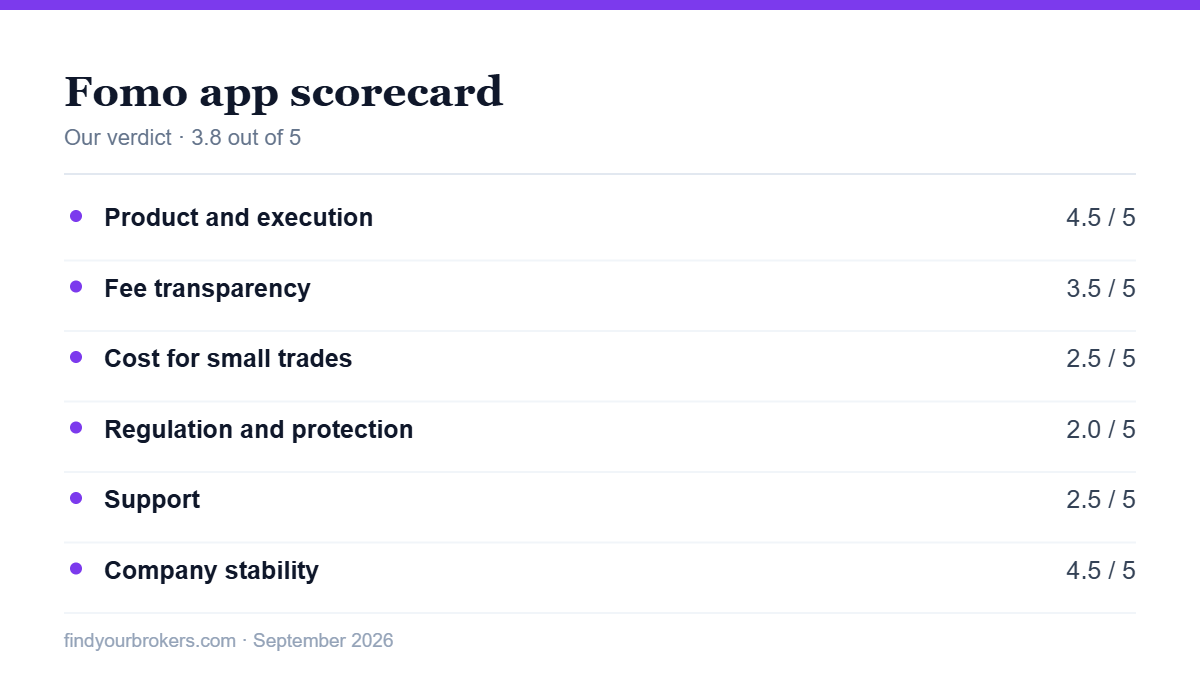
- Our rating: 3.8 out of 5.
If you trade in sizes above roughly $200 and you understand that you are buying unregulated, self-custodied exposure to volatile tokens, the Fomo app is a genuinely well-built tool. If you are placing $10 and $20 trades to “test it out”, you are paying a rate that would embarrass most brokers. That gap is the whole review.
What the Fomo App Actually Charges
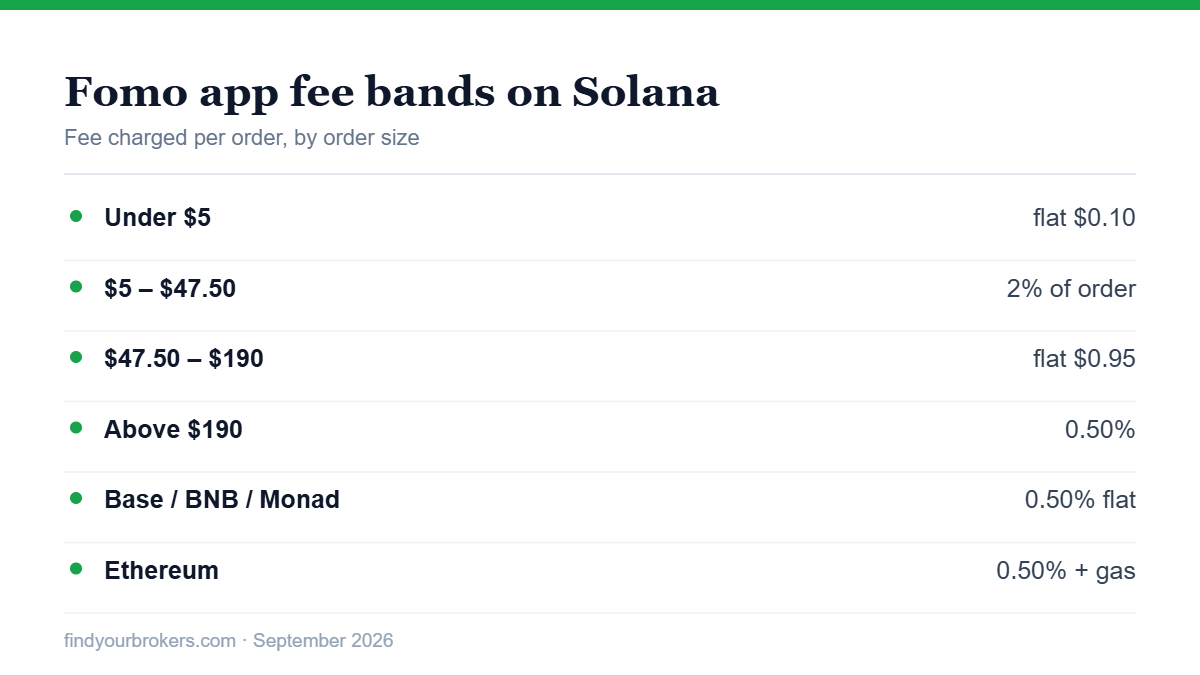
On Base, BNB Chain, Monad and Robinhood Chain the Fomo app charges a flat 0.50% per trade and absorbs the gas. On Ethereum it is 0.50% plus network fees, which are passed through to you. Solana — the chain most of the app’s memecoin activity sits on — works on tiers instead:
- Under $5: a flat $0.10
- $5 to $47.50: 2% of the order
- $47.50 to $190: a flat $0.95
- Above $190: 0.50%, the advertised rate
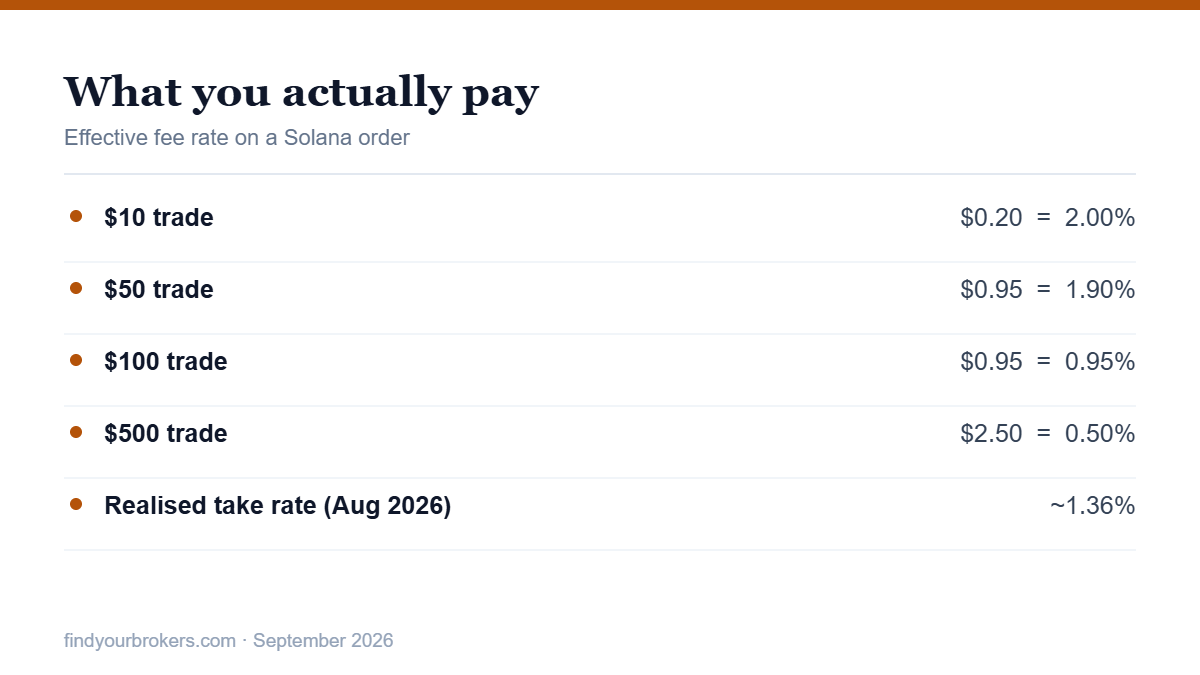
Run that through real numbers and the shape becomes obvious. A $50 trade costs $0.95, or 1.90%. A $100 trade costs the same $0.95, so 0.95%. A $500 trade costs $2.50, and only there does the Fomo app charge what the marketing says. The $190 threshold is the line where the headline rate begins to be true.
None of this is hidden — the fee is shown in the app before you confirm, and that displayed figure is binding for that trade. But it is not what a new user infers from “0.50%”, and it is the single most useful thing to know before you fund an account. You can check the current fee shown on your own first order before committing anything.
Perpetuals, Referrals and the Other Line Items
The Fomo app added perpetual futures, routed through third-party venues including Hyperliquid. Fomo takes 0.05% per transaction, applied when you open and again when you close; the venue’s own taker fee sits on top, so a round trip lands near 0.095% per side. Perps and Robinhood-chain tokens are restricted to non-U.S. persons, and the terms explicitly prohibit using a VPN to get around that.
A referral code takes 10% off the standard rate permanently — 0.50% becomes 0.45%. It is applied at signup and cannot be added later, which is the one genuinely time-sensitive decision in the whole onboarding. Referrers earn a share of their invitees’ fees, so treat any glowing “review” attached to a code, including the link in this article, with the scepticism that deserves.
Two costs sit outside the published table. Launchpad fees are charged by token creators and are not part of the Fomo app’s own schedule. And DefiLlama data from August 2026 put the realised take rate across actual volume at roughly 1.36% — a number that says most trades on the platform are small ones landing in the expensive bands, not $500 orders paying 0.50%.
Custody, Regulation and What You Are Actually Signing
This is where the Fomo app needs to be read carefully rather than skimmed. The terms state plainly that FOMO is not registered with or licensed by any regulatory authority and does not act as your financial advisor. There is no FDIC or SIPC protection, because there is nothing here for those schemes to apply to.
Custody is non-custodial: your trading wallet is yours, provisioned via Privy, and safeguarding access to it is your responsibility. Signup is through Apple ID or Google, so there is no seed phrase to write down — convenient, and also a real dependency on an account you may not think of as a crypto account. Identity verification applies if you fund with fiat through Apple Pay or a debit card. Residents of sanctioned jurisdictions including Cuba, Iran, North Korea and Venezuela are excluded.
There is no hardware wallet integration. If your mental model of safe crypto involves a Ledger, the Fomo app does not fit it.
Scale, Funding and Why That Matters
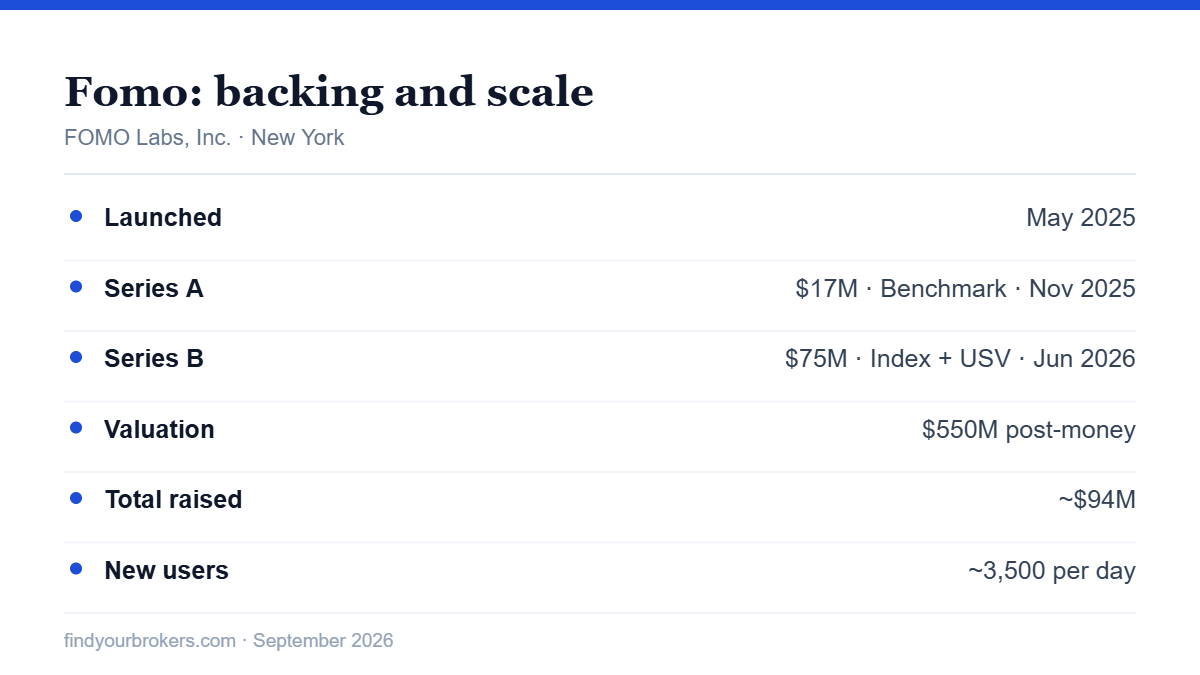
Launched in May 2025 by Paul Erlanger and Se Yong Park, the Fomo app raised an unusual seed round from roughly 140 angel investors — among them Raj Gokal of Solana, Marc Boiron of Polygon Labs and Balaji Srinivasan. Benchmark led a $17 million Series A in November 2025, a rare crypto position for that firm. In June 2026, Index Ventures and Union Square Ventures led a $75 million Series B at a $550 million post-money valuation, with Mark Pincus and Kevin Hartz among the participants.
Total funding is therefore about $94 million, and the company reported onboarding around 3,500 new users a day at the time of that round. For a review, the relevant read is simple: the Fomo app is not a fly-by-night operation and is not likely to vanish next quarter. Funding is not regulation and it is not a guarantee, but it does change the failure modes you should worry about.
The Complaints Worth Taking Seriously
The public record on the Fomo app is unusually split. The iOS listing sits at 4.8 out of 5 from about 16,000 ratings. Trustpilot shows 2.3 out of 5 — but from six reviews, all one-star, on a profile Trustpilot itself flags as possibly unrepresentative because the company has not invited customers to review it. Six reviews is not a sample, and anyone quoting that score as though it were is misleading you.
The substance of those complaints still deserves airing, because it recurs elsewhere:
- Failed sells. Several users report buys executing while sells fail. On thin memecoin liquidity this is often the token’s problem rather than the app’s, but the user experience is identical either way.
- Verified-looking scam tokens. A blue tick on a listing is not an endorsement of the token’s economics.
- Support. Email only, no live chat, and slow responses are a consistent theme across independent reviews.
- Withdrawal friction. Deposits are smooth; withdrawals attract verification steps that surprise people who signed up in thirty seconds.
If you want to form your own view rather than take anyone’s, the honest approach is a small first position — accepting that a small position on Solana is exactly the one that pays the worst rate. You can open the app and read the fee on a live order without funding anything.
Who the Fomo App Is Right For
A good fit if: you already trade on-chain, you want one interface across Solana, Base, BNB Chain and Ethereum without bridging, your typical order is $200 or more, and you value a social feed and leaderboard as a discovery tool rather than a signal service.
A poor fit if: you want regulated custody and investor protection, you trade in $10 and $20 clips, you need responsive human support, or you would be copying leaderboard traders without understanding what they are holding. Copying a leaderboard is the single fastest way to lose money on any social trading product, and the Fomo app makes it very easy.
Bottom Line
The Fomo app is a well-engineered, seriously funded product with a fee structure that is transparent at the point of trade and misleading in the headline. It is not regulated, it does not hold your assets, and it points a very smooth interface at some of the most volatile instruments in retail finance. Rated on execution it is strong; rated on suitability for an inexperienced trader it is not.
Our rating is 3.8 out of 5. If you decide it fits, apply a referral code at signup for the permanent 10% fee reduction — it cannot be added afterwards. You can sign up with the 10% fee discount applied, and if you want to see the interface before deciding, browse the live feed and leaderboard first.
Fomo App FAQ
Is the Fomo app legit?
It is a real company — FOMO Labs, Inc. in New York, backed by Benchmark, Index Ventures and Union Square Ventures at a $550 million valuation. It is not, however, registered with or licensed by any regulator, and it says so in its own terms.
What does the Fomo app cost per trade?
0.50% on Base, BNB Chain, Monad and Robinhood Chain, and 0.50% plus gas on Ethereum. On Solana it is tiered: $0.10 under $5, 2% from $5 to $47.50, a flat $0.95 from $47.50 to $190, and 0.50% above $190.
Does the Fomo app hold my crypto?
No. The wallet is non-custodial and provisioned through Privy. You are solely responsible for safeguarding access, and there is no FDIC or SIPC cover.
Can I get a fee discount?
Yes — a referral code applied at signup permanently reduces the standard rate by 10%, so 0.50% becomes 0.45%. It cannot be applied to an existing account afterwards.
Is the Fomo app available in the US?
Spot trading is, but perpetual futures and Robinhood-chain tokens are restricted to non-U.S. persons. Residents of sanctioned jurisdictions such as Cuba, Iran, North Korea and Venezuela are excluded entirely, and circumventing those restrictions with a VPN breaches the terms.
Why is the Trustpilot score so low?
Because it rests on six reviews. Trustpilot itself notes the company has not invited customers, so the sample is not representative. The App Store figure — 4.8 from roughly 16,000 ratings — is the better-powered number, though it skews toward users who are currently winning.