Funded Trader Markets Instruments 2026: 76 Symbols, Swap-Free, What Each One Costs
Funded Trader Markets instruments reviewed: 76 symbols, 39 of them crypto, zero swap across the table, 7 dollars per lot on forex and zero on indices and crypto.
Overview
Funded Trader Markets instruments at a glance
Overall: 4.7 / 5. The Funded Trader Markets instruments list is published in full on a single page, and it is more specific than most prop firms bother to be: 76 symbols, each with its digits, contract size, swap and commission set out in one table you can read before you pay for anything.
Three things stand out. Swap is 0% on every row of the Funded Trader Markets instruments table, forex and metals and commodities carry a flat $7 per lot commission, and indices and crypto carry $0. Crypto is the largest group on the board, not forex.
This review covers the Funded Trader Markets instruments and trading conditions only. For the programs, the drawdown rules and the reward process, that is a separate question with its own answers.
The full Funded Trader Markets instruments table is published openly, which is the right place to start if you want to price a strategy before committing to an evaluation fee.
How this review was done
A desk review. Every number below was read from the Funded Trader Markets instruments and specification page, the Trading Update notices, the tools page and the site footer in October 2026. Nothing was tested with money.
That is deliberate, and it is worth saying plainly: Funded Trader Markets is not a licensed broker. Its own footer states that all accounts are simulated and that nothing on the site is investment advice. There is no live account to fund, so there is no live execution to measure. What can be verified is what the company publishes about its own Funded Trader Markets instruments, and that is what this page checks.
What the Funded Trader Markets instruments list actually contains
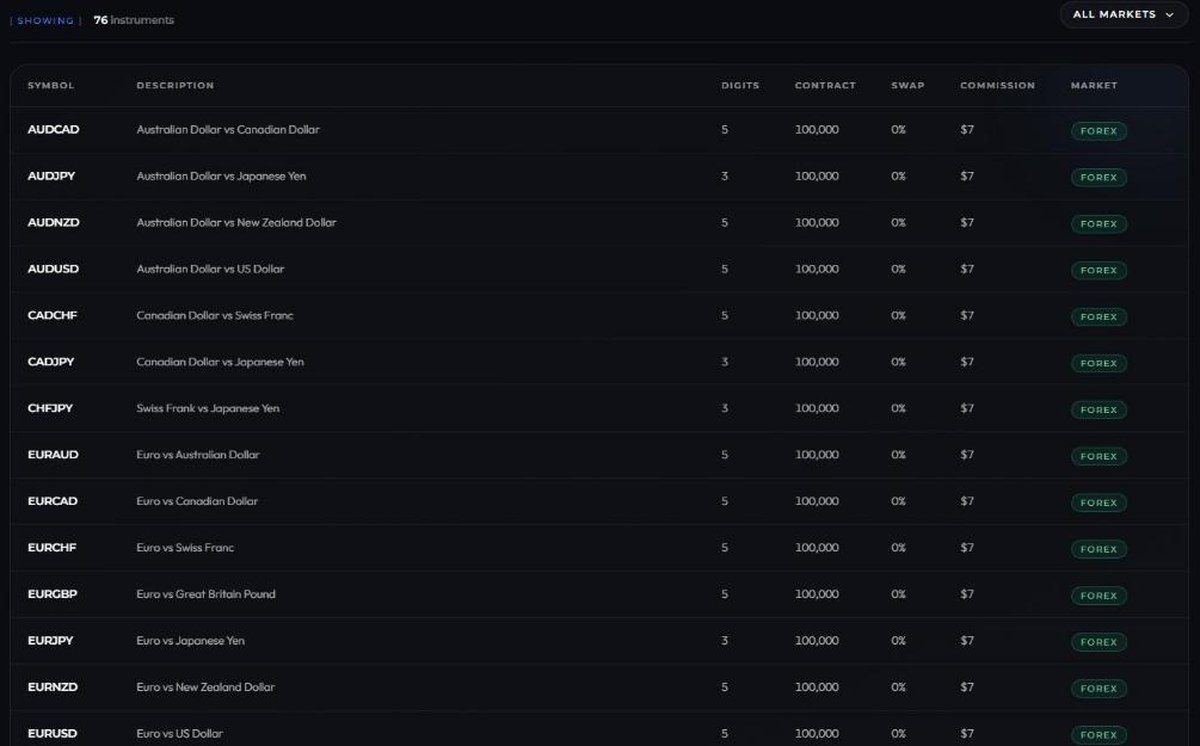
The counter at the top of the Funded Trader Markets instruments table reads 76 instruments, and a market filter lets you narrow the view. Counted by market tag, the Funded Trader Markets instruments break down like this:
- Crypto — 39 symbols. The largest group by a clear margin.
- Forex — 27 pairs. Majors and crosses, no exotics.
- Indices — 6 CFDs. GER40, JAP225, UK100, US100, US30, US500.
- Metals — 2. XAUUSD (gold) and XAGUSD (silver).
- Commodities — 2. BRENT and WTI crude.
Each row carries five specification columns: digits, contract size, swap, commission and market. That is the whole contract spec in one line, which is unusual for a prop firm and genuinely useful when you are sizing a position.
Crypto is the biggest group on the board, not forex
Most prop firms are forex shops with a few extras bolted on. The Funded Trader Markets instruments board is not shaped that way: 39 of the 76 symbols are crypto, against 27 forex pairs.
The crypto list runs well past the obvious names. Alongside the majors it carries AAVEUSD, ALGOUSD, APTOSUSD, ATOMUSD, AVAXUSD, BCHUSD, CAKEUSD, DASHUSD, DOTUSD, DYDUSD, EGLDUSD, ETCUSD, FILUSD, GRTUSD, HBARUSD, IMXUSD, LINKUSD, MKRUSD, NEARUSD, THETAUSD, TONUSD, UNIUSD, XLMUSD, XMRUSD and XTZUSD among others.
If your edge is in altcoins rather than majors, that matters more than any headline profit split. It also means the Funded Trader Markets instruments board behaves differently at the weekend from a pure forex firm’s, since crypto does not stop when the FX session does.
Commission: $7 on forex, metals and commodities, $0 on indices and crypto
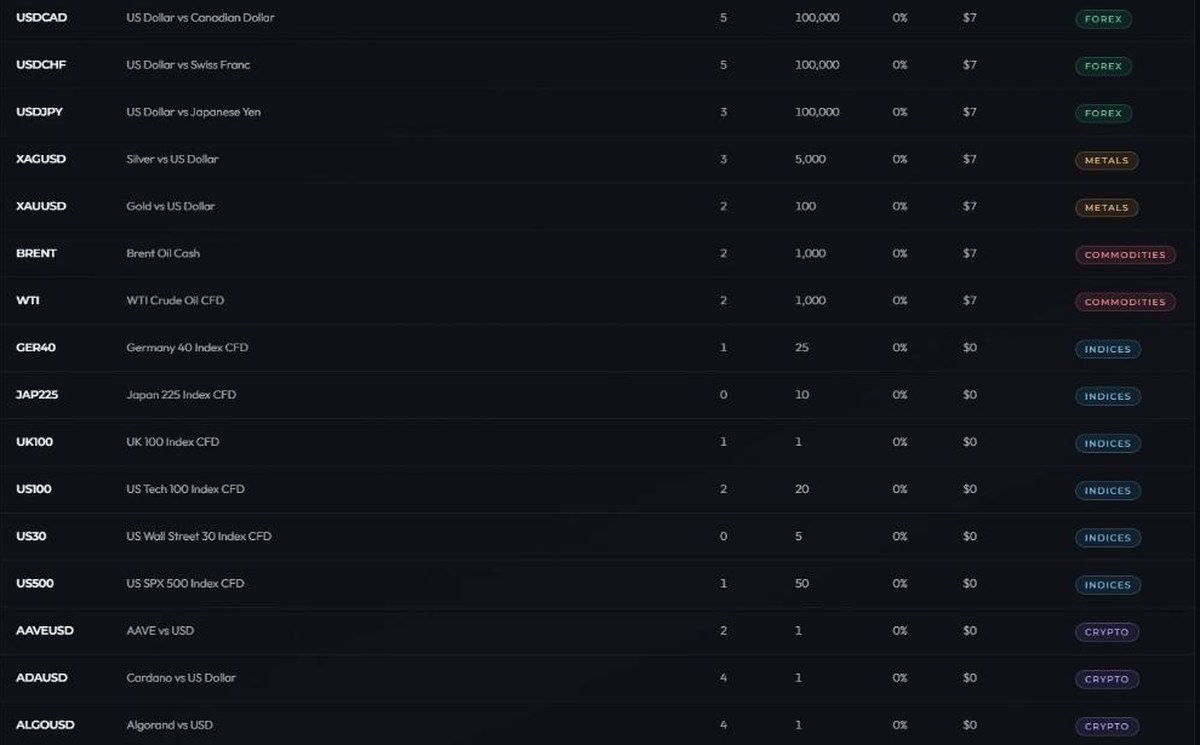
The Funded Trader Markets instruments commission column is flat within each market, and it is the clearest cost signal on the whole page.
- Forex — $7 per lot. Every one of the 27 pairs, from AUDCAD to USDJPY.
- Metals — $7. Both XAUUSD and XAGUSD.
- Commodities — $7. Both BRENT and WTI.
- Indices — $0. All six index CFDs.
- Crypto — $0. All 39 pairs. The platform’s own instrument notice describes them as available “with competitive spreads and zero commission”.
So the Funded Trader Markets instruments split cleanly into a commission book and a spread-only book. On indices and crypto your entire cost is the spread; on forex, metals and oil you add $7 per lot on top. Worth noting that the spread itself is not published in this table, so the spread-only markets are the ones where you cannot see the full cost in advance.
Swap is 0% across every Funded Trader Markets instruments row
Every single row of the Funded Trader Markets instruments table shows swap 0%. Not reduced, not tiered by instrument — zero, on forex, metals, commodities, indices and crypto alike.
For a swing trader this is the most valuable line on the page. Overnight financing is the cost that quietly eats multi-day positions, and a firm that charges none of it removes a variable from the plan entirely. It also makes the account usable for traders who avoid interest for religious reasons, without having to apply for a special account type.
Because these are simulated accounts rather than live broker accounts, zero swap is a modelling choice rather than a financing arrangement. That is not a criticism — it is simply why the number can be a clean zero everywhere.
Reading the Funded Trader Markets instruments contract size column properly
The contract column is where traders new to the Funded Trader Markets instruments board most often misjudge size, because the figures differ by orders of magnitude:
- Forex — 100,000. The standard lot.
- XAGUSD (silver) — 5,000. XAUUSD (gold) — 100.
- BRENT and WTI — 1,000.
- Indices — GER40 is 25, JAP225 is 10, UK100 is 1, US100 is 20, US30 is 5, US500 is 50.
- Crypto — 1. One unit of the coin per lot, across the board.
One lot of gold and one lot of EURUSD are not remotely the same exposure, and one lot of US30 is not the same as one lot of US500. The digits column sits next to it for the same reason: five digits on most forex pairs, three on the yen crosses, two on gold, zero on JAP225 and US30. Price a stop in pips without checking those two columns and the risk calculation will be wrong before the trade is open.
The symbols themselves follow the same three-letter currency convention the rest of the market uses, defined by ISO 4217, which is why AUDCAD and XAUUSD read the same here as they do anywhere else.
The calculators do the arithmetic for you
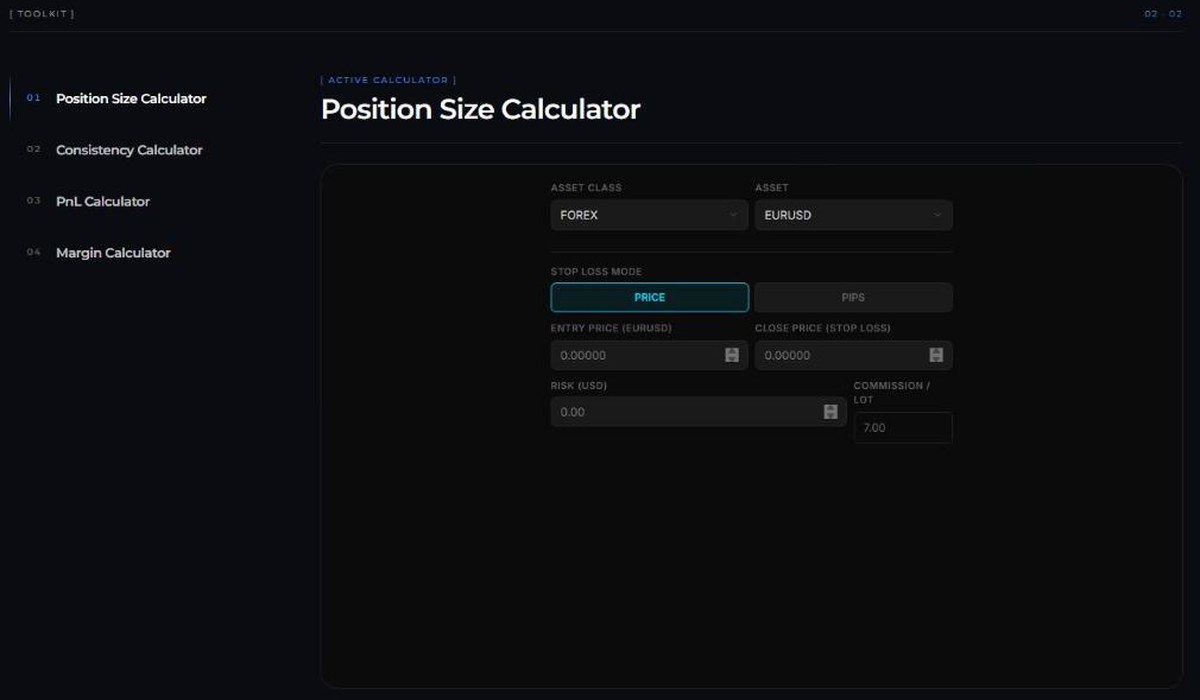
The site publishes four calculators for sizing trades on this board, and they take the same inputs the Funded Trader Markets instruments table supplies:
- Position Size Calculator — asset class, asset, stop-loss in price or pips, risk in dollars, and a commission-per-lot field that defaults to 7.00 for forex.
- Consistency Calculator — for checking a day’s profit against the consistency requirement before it becomes a problem.
- PnL Calculator.
- Margin Calculator.
The commission field being pre-filled with the real number, rather than left at zero, is a small sign of a desk that expects you to include costs in your sizing.
The delisting notice, and a mismatch worth knowing about
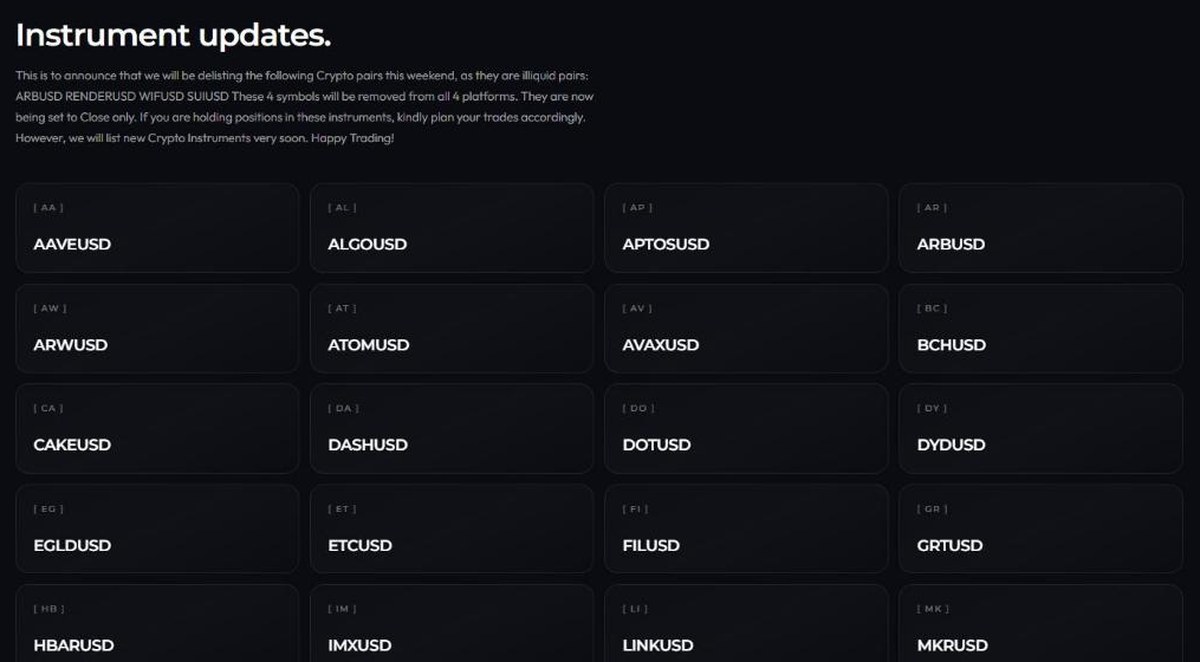
The Funded Trader Markets instruments board is maintained rather than left to rot. An Instrument Updates notice announces the removal of four crypto pairs — ARBUSD, RENDERUSD, WIFUSD and SUIUSD — described as illiquid, set to close-only before being taken off “all 4 platforms”, with a promise of new crypto listings to follow.
Telling traders in advance that a symbol is going close-only is good practice; being caught holding a position in an instrument that disappears is a genuinely unpleasant surprise.
One mismatch should be recorded rather than smoothed over. At the time of writing, all four of those pairs still appear in the 76-symbol specification table, while the notice says they are being delisted. Both statements are published by the company on the same site. Check the live table for the symbol you intend to trade rather than relying on either page alone.
Funded Trader Markets instruments: market hours and the Trading Update desk
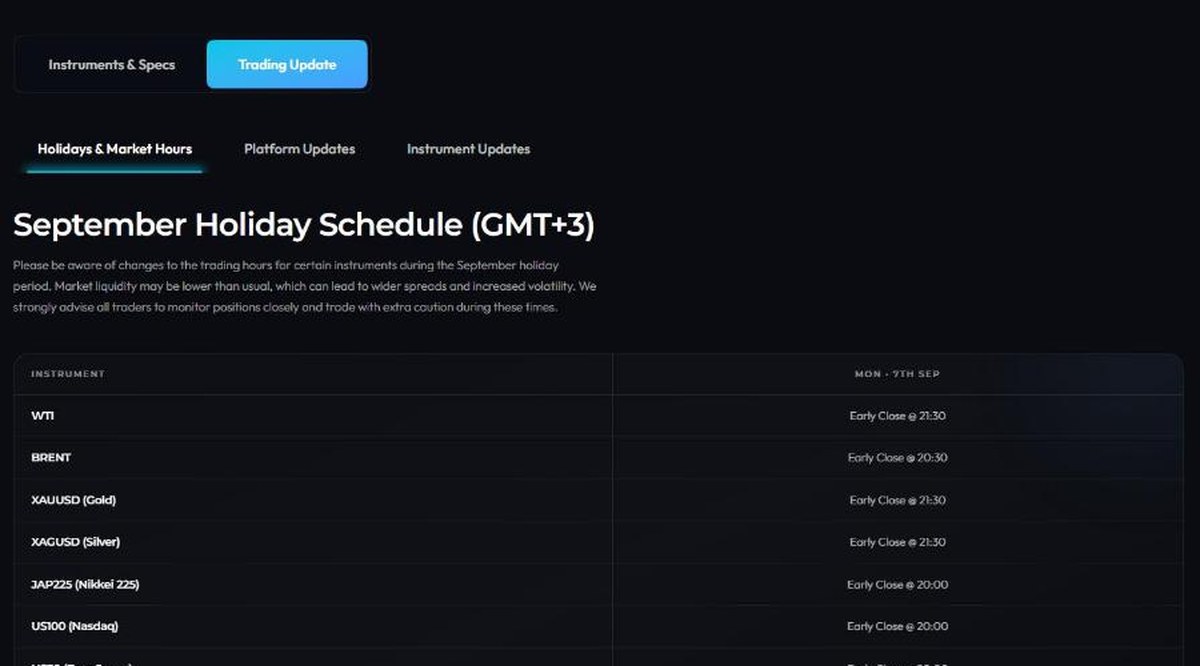
Sitting beside the Funded Trader Markets instruments table is a Trading Update section with three tabs: Holidays & Market Hours, Platform Updates and Instrument Updates.
The holiday tab publishes an early-close schedule for the Funded Trader Markets instruments, symbol by symbol — the notice visible at the time of writing covered a September holiday period in GMT+3, listing early closes for WTI, BRENT, XAUUSD, XAGUSD, JAP225, US100, US30, US500, GER40 and UK100, with times running from 20:00 to 23:00. It also carries the warning that liquidity may thin out and spreads widen around those dates.
Treat the specific times as an example of what the desk publishes rather than as current hours; check the tab for the period you are actually trading.
Platforms, and which company holds which licence
The Funded Trader Markets instruments are offered through named platforms, and the footer is unusually specific about who holds what:
- MetaTrader 5 — the licence sits with Funded Trader Markets LTD, incorporated in Saint Lucia, registration 2025-00239.
- cTrader and TradeLocker — those arrangements sit with Formed Technologies INT FZCO, incorporated in the UAE, registration 36580, at Building A1, Dubai Digital Park, Dubai Silicon Oasis.
A second mismatch belongs here: the footer names three platforms, while the delisting notice refers to “all 4 platforms”. Both are the company’s own wording and neither explains the other, so the count is recorded as published rather than guessed at.
The footer also states that cTrader and MetaTrader 5 services “are not intended for U.S. residents”, which is the clearest statement on the site about who should not be opening an account.
Who is behind the Funded Trader Markets instruments, and who regulates them
Three entities stand behind the Funded Trader Markets instruments, each with a stated job:
| Entity | Jurisdiction | Role |
|---|---|---|
| Formed Technologies INT FZCO | UAE, reg. 36580 | The contracting entity for all clients |
| FTM Funded Trader Markets LTD | Cyprus, reg. HE462185 | Payment agent, receiving payments on behalf of the UAE entity |
| Funded Trader Markets LTD | Saint Lucia, reg. 2025-00239 | Holds the MetaTrader 5 licence |
These are company registrations, not financial licences. No financial regulator supervises the Funded Trader Markets instruments or the accounts they trade on, there is no compensation scheme and no ombudsman. To the firm’s credit it never claims otherwise: the footer states the service is educational, simulated and not investment advice, and that the site does not endorse any broker, instrument or trading platform.
Read the company’s own disclosures before paying an evaluation fee rather than taking any review’s word for it, this one included.
Restricted countries: two lists that do not match
This is the third mismatch, carried over from the firm’s own documents and worth repeating because it affects whether you can use the service at all.
- The footer lists nine: Cuba, Syria, Iran, Lebanon, Iraq, Yemen, North Korea, Russia and Cyprus.
- The Terms list twelve: the same nine plus Myanmar, Belarus and Vietnam.
Cyprus appears on both, which is notable given one group entity is registered there. If your country is on either list, or is borderline, settle it with support in writing before buying anything. Both lists are published by the company; neither supersedes the other on its face.
Who this suits
The Funded Trader Markets instruments board suits a trader who already knows their market and wants to price it before paying. The Funded Trader Markets instruments board suits crypto traders particularly well, since 39 of 76 symbols are crypto at zero commission. It suits swing traders, because zero swap across the table removes the holding cost. And it suits anyone who prefers a firm that publishes contract specs, delisting notices and holiday hours in public rather than behind a login.
It suits less well a trader who needs exotic FX pairs or single-stock CFDs, neither of which is on the board; anyone who needs a regulated counterparty; and anyone trading from a country on either restricted list.
If the board fits your strategy, the specification page and the Trading Update tabs are the two pages worth reading first, and the calculators are worth running before the first trade rather than after it. Readers comparing the tooling side of this may also want our MenthorQ pricing review and our MenthorQ gamma levels guide, both of which look at what a trader pays for market structure data. And if you are weighing the programs rather than the instruments, start from the firm’s own program pages.